



Edition de luxe
Die Liste enthält 7 Einträge. Suchergebnisse löschen und Gesamtbestand anzeigen.
| Abbildung |
Beschreibung Gesamte Buchaufnahme |
Preis EUR |
|
|---|---|---|---|
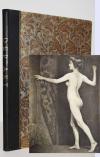 |
Krull, Pésci und Debschitz-Kunowski – Der Akt. Zwanzig photographische Aufnahmen weiblicher Körper nach der Natur. Liebhaber-Ausgabe auf Japan, Nummer 4. Dachau, Einhorn-Verlag 1918. Folio (40,7 x 30,5 cm.). Typographischer Titel in Ocker und Schwarz auf Japanpapier und 20 mont. Fotogravüren in Kupfertiefdruck. Orig.-Halblederband mit goldgepr. Rückentitel.
Bertolotti 51. Heidtmann 11127. Heiting/Jaeger II, 150 ff. Sichel, Krull 14 ff. – Erste Ausgabe. – Nr. 4 von 50 Exemplaren der Luxusausgabe auf Japan-Papier im Halbledereinband. – Erste Veröffentlichung der erst 21jährigen G. Krull, die nach ihrem Studium in München 1917 ein eigenes Fotoatelier eröffnet hatte. – Die Aktaufnahmen in Kupfer-Handpressendruck von J(osef) Pésci (4), W(anda) v. Debschitz-Kunowski (9) und Germaine Krull (7). – „Der in einer limitierten Auflage herausgegebene Band enthält 20 „photographische Aufnahmen weiblicher Körper nach der Natur“ als Handpressen-Kupferdrucke. 1920 erschien eine zweite Auflage“ (E. Kaufhold in Heiting/Jaeger). – „Germaine Krull established herself as an avant-garde artist in Paris in the 1920s. She had begun to study photography in 1918 in Munich, stimulated by the cultural and political atmosphere in the Bavarian capital, where students, political activists, and artists such as Thomas and Heinrich Mann, Vassily Kandinsky, Richard Strauss, and Rainer Maria Rilke met to dicuss their ideas and projects. Krull later specialized in portrait and nude photography. … The prints were of remarkably high quality, and where pasted onto the leaves by the photographers themselves, who could not afford to pay someone else to do the job. All the nudes are female, and the classicism of the poses, the smoothness of the shadows, the choise of settings, and the printing technique are reminicent of the style of the pictorialist Frank Eugene, who had been the teacher of the photographers represented, and who had just published Hawe, a portefolio of twelve male nudes“ (A. Bertolotti). – „Germaine Krull still seems to be searching for her own photographic language, wavering, as she does, between the photographic styles of her more mature colleagues. Krull used more natural daylight settings, which does give her images a less formal mood. The works included in this book are like photographed versions of classical academic studies. Many are reminiscent of the works of painters, such as the German artist Georg Papperitz. This publication is widely known as Germaine Krull’s first book publication, and therefore an important and appreciated volume amongst photobook lovers. Though the youngest photographer featured here, Krull went on to become the best-known of them all“ (Andreas H. Bitesnich in achtung.photography). – Titel und wenige Tafeln leicht braunfleckig, sehr gutes Exemplar. Schlagwörter: Aktphotographie, Edition de luxe, Nummerierte Bücher, Vorzugsausgaben |
8.500,-- |  |
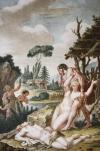 |
Gessner, Salomon. Mort d’Abel. Poëme de Gessner. Édition ornée d’estampes imprimées en couleur d’apres les dessins de M. (Nicolas André) Monsiau, peintre de l’Académie. (Traduit de l’allemand par Michel Huber). Paris, Defer de Maisonneuve 1793. Folio (36 x 26,5 cm.). 161 S. mit 6 Farbstichen (inkl. Frontispiz) in Punktierstich von (Nicolas) Colibert, (Jean-Frédéric) Casenave und (Pierre-Charles) Clément nach N. Monsiau. Halbpergamentband der Zeit mit goldgepr. Rückenschild.
Brunet II, 1568. Cohen-de Ricci 436. Fürstenberg 122 und 205. Leemann-van Elck 699. Lewine 211. Sander 780. – Seltene Luxusausgabe auf „grand papier vélin“ mit sechs farbigen Punktierstichen „avant la lettre“ nach Aquarellen von N. A. Monsiau (1754-1837). – Der Pariser Verleger Defer de Maisonneuve veröffentlichte seit 1791 eine Reihe kostbarer illustrierter Bücher, deren Farbstiche allerdings nicht durch Mehrplattendruck, sondern von einer Platte in Punktiermanier nach englischem Vorbild hergestellt worden waren. „Die bekanntesten unter ihnen sind Florians Galatée und Gessners Mort d’Abel, die beide 1793 mit Farbstichen nach Monsiau von Cazenave, Colibert u. a. prächtig gedruckt wurden“ (Lexikon des Buchwesens I, 237). – „Eine nur kurze Blüte auf dem Gebiete der Buchillustration erlebte der aus England eingeführte, in Frankreich zu höchster technischer und künstlerischer Vollendung gelangte Farbstich wahrend der neunziger Jahre in einer kleinen Zahl in beschränkter Auflage hergestellter Prachtpublikationen des Verlegers Defer der Maisonneuve, die in ihrer Zeit keine Nachfolge fanden“ (Kat. Furstenberg S. 88). – Stellenweise im weißen Rand leicht fleckig, gutes breitrandiges, seitlich und unten unbeschnittenes und sauberes Exemplar. Schlagwörter: Edition de luxe, Illustrated books, Illustrierte Bücher |
750,-- | |
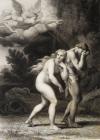 |
Milton, John. Le paradis perdu. Traduction de (François-René) de Chateaubriand, précédé de réflexions sur la vie et les écrits de Milton par (Alphonse) de Lamartine. Et enrichi de vingt-cinq magnifiques estampes originales gravées au burin sur acier (par Edouard Richomme, Raymond-Auguste-Quinsac Monvoisin, Marie-Alexandre Alophe, Raymond Pelee et Jean-Nicolas Laugier d’apres Jean-Jacques Flatters, Pierre-Roch Vigneron et autres). Paris, Bigot et Voisvenel, Amable Rigaud et Furne 1855. Imperial-Folio (55 x 39 cm.). XXXI, 157 p. avec 3 portraits et 22 planches hors-texte gravées. Reliure en demi-cuir de l’éditeur, avec titre estampé à l’or sur le dos et dorure sur le dos.
Carteret III, 408. Vicaire V, 871. – Édition monumentale très rare sur grand papier vélin, les planches étant imprimées sur papier de Chine. – „Monumentale publication romantique, recherchée pour son illustration qui comprend 25 superbes planches hors-texte gravées sur acier par les meilleurs burinistes de l’époque d’après les compositions d’un style classique et dramatique de J.-J. Flatters. L’ouvrage contient également les portraits de Milton, de Chateaubriand et de Lamartine“ (L. Carteret). – „Il a été tiré quelques rares exemplaires en grand papier vélin avec les figures sur papier de Chine appliqué“ (G. Vicaire). – Les illustrations s’inspirent d’un cycle de 56 dessins réalisés par Jean-Jacques Flatters (1786-1845) en 1836 et qui devaient être publiés dès 1837 dans une édition monumentale. Le projet ayant échoué sur le plan financier, seuls les deux premiers chants furent imprimés à l’époque, et seules 12 de ses illustrations furent reproduites. Ce n’est que dix ans après la mort de Flatters que l’éditeur Amable Rigaud acquit les droits et acheva l’ouvrage. Parmi les 56 dessins, les 25 motifs les plus marquants et les plus dramatiques furent sélectionnés, puis transposés sur des plaques d’acier par les meilleurs graveurs sur cuivre de France. – Présente des taches brunes sur l’ensemble de la page, principalement sur les bords des pages ; sinon, très bien conservée. Schlagwörter: Edition de luxe, Illustrated books, Illustrierte Bücher, Vorzugsausgaben |
500,-- | |
 |
Cals, Rose (en fait Jeanne Ramel-Cals). Rose. Roman. Paris, Arthème Fayard & Cie. 1918. 8°. 268 p., [1] f. Reliure en demi-cuir maroquin rouge rouille avec titre sur le dos estampé à l’or (couverture typographique reliée).
Exemplaire n° 9 sur 15, sur papier du Japon; Vingt-cinq exemplaires sur papier de Hollande numérotes de 16 à 40. – Première édition de cette publication très rare. – Jeanne Ramel-Cals (née Jeanne Gibert, 1883-1976) „Ses parents dirigent la tannerie familiale située sur la route de Graulhet. Sa mère est une femme d’esprit qui reçoit chez elle des personnalités telles que Jean Jaurès et correspond avec Maurice Maeterlinck. … Installée à Paris, Jeanne trouve rapidement sa voie dans l’écriture, elle devient journaliste et, sous le nom de Jeanne Ramel-Cals, tient des chroniques régulières dans divers journaux tels que Candide, Le Crapouillot, Le Matin, Le Petit Journal, Le Jour, Le Journal illustré ou La Revue de la femme, ainsi que dans la presse régionale comme Septimanie, Sud-Ouest ou La Dépêche du Midi. Parallèlement à sa carrière de journaliste, Jeanne publie des romans qui rencontrent rapidement le succès, notamment ses souvenirs d’enfance dans Vacances à Villefranche. … Le critique littéraire Paul Reboux disait d’elle : „Elle a surtout beaucoup regardé autour d’elle, d’un regard amusé, narquois et pénétrant. C’est ainsi qu’elle a pu observer les choses et les gens, fixer les traits qui lui semblaient cocasses, et nous donner les plus savoureux albums psychologiques dont on puisse se délecter“. André Billy écrit qu’il „l’aime mieux dans l’ironie et la satire. Son talent est assez inégal, elle compose mal et ne sait pas finir. Mais le petit air qu’elle nous joue, tout parsemé de fausses notes qu’il soit, est bien à elle. Elle en tire des effets drolatiques et piquants“. En 1936, lors de la sortie de Le jardin, Gus Bofa écrit que „Jean Ramel-Cals est une petite fille qui a grandi sans le faire exprès. Elle a conservé, tout frais, tous les souvenirs et les idées de son enfance“.“ (Wikipedia). – Le dos est légèrement usé par endroits, mais le livre est par ailleurs en très bon état. Schlagwörter: Edition de luxe, Erstlingswerk, Nummerierte Bücher, Première publication, Vorzugsausgaben |
200,-- | |
 |
Flaubert, Gustave. Salammbô. Dix compositions par (Victor)-A(rmand) Poirson gravées à l’eau-forte par Louveau-Rouveyre, L. Muller et G. Mercier. Paris, Maison Quantin s. d. (1887). Gr.-4° (29,3 x 21,5 cm.). [3] f., 366 p., [1] f. avec deux suites de 10 gravures hors-textes. Reliure originale en plein maroquin décorée avec de petits lions estampés en doré, des filets sur le couvercle, des bords intérieurs dorés et une tranche dorée.
Monod 4692. Talvart/Place 2. G. Vicaire II, 349. – Première édition illustrée. Édition de luxe sur Japon en grand format, tirée à 50 exemplaires, avec deux suites des 10 gravures hors-textes. Exemplaire personnel de l’illustrateur Armand Poirson avec note manuscripte de l’editeur. – Victor-Armand Poirson (1858-1893) illustrée aussi L’Âne de Lucius (traduction de Paul-Louis Courier) en 1887, La Guerre de Carlo du Monge en 1886, Le Conte de l’archer d’Armand Silvestre en 1883 (aquarelles gravées par Gillot). Il a également travaillé pour les journaux illustrés La Vie moderne, Le Chat noir et Le Journal de la jeunesse. – Dos légèrement décoloré, très bel exemplaire magnifiquement relié. Schlagwörter: Edition de luxe, Einbände, Einbandkunst, Illustrated books, Illustration des livres, Illustrierte Bücher, Nummerierte Bücher, Signierte Bücher, Vorzugsausgaben |
850,-- | |
 |
Boltanski, Christian, Christiane Büchner u. Andreas Fischer. La maison manquante. – The missing house. Paris, La Hune (1992). Folio (33,5 x 24,5 cm.). 7 Mappen und 1 Umschlag mit Faksimiles und 4 (2 farbige) Orig.-Photographien. Orig.-Pappkassette mit Deckelschild.
Nr. 68 von 100 num. Exemplaren (GA 120 Exemplare). Im Druckvermerk von C. Boltanski signiert. – „À Berlin, au 15, Grosse-Hamburger-Strasse, il y a une maison assez bien conservée, avec en son centre une petite cour bordée par deux bâtiments portant au-dessus de leur porte d entrée les lettres A et C peintes en noir. Le bâtiment B à disparu dans un bombardement un jour de février 1945: à sa place il y a un vide. Nous avons voulu rechercher ceux qui ont vécu là, entre 1930 et 1945, aujourd hui ils sont presque tous morts: d’abord les habitants juifs déportés et exterminés, puis ceux qui occupèrent leurs appartements réquisitionnés enfouis sous les bombes. Mais la mémoire reste, et chaque lieu chaque histoire devient exemplaire“ (C. Boltanski). – Anlässlich der Ausstellung „Die Endlichkeit der Freiheit“, Berlin 1990, entstand das Werk „The Missing House“. Dabei suchte er als Ort für seine Erinnerungsarbeit die Große Hamburger Straße 15/16. Boltanski und seine Mitarbeiter bemühten sich, diesen Raum als Stätte der Erinnerung und gleichzeitig als poetischen Ort zu konstruieren; dabei wurden durch intensive Recherche lebende und papierne Zeugen gesucht und gefunden, so z.B. Photoalben, Adressbücher, Interviewabschriften, Originalphotos, Postkarten und andere Fundstücke, die in einem „Museum“ in Glasvitrinen gezeigt wurden. In dieser Kassette zusammengefaßt sind diese unzähligen Dokumente und Fotos, die als aufwendige Faksimiles Authentizität beweisen. – „In der erinnerten Erinnerung der privaten Photos tritt eine neue Bedeutung in Erscheinung: die Verquickung von Privatem und Politischem, hatten doch die Verbrechen des Zweiten Weltkrieges ihre Voraussetzungen und Auswirkungen im Leben jedes einzelnen Deutschen. Obwohl die Bilder vom familiären Glück, vermeintlich sorgenfrei“, diesen Zusammenhang gerne verdrängen, deckt Boltanski ihn doch allein durch die Reproduktion und Präsentation der Bilder auf“ (H. Dickel zu „Sans-Souci“ Köln 1991). – Christian Boltanski (1944-2021) „was a conceptual artist. He had become known for his installations of memory inventories, which often take almost monumental proportionss. In 1972, 1977, and 1987 he participated at documenta 5,6 and 8. In 2011 he represented France at the Venice Biennale. He lived with his wife Annette Messager in Malakoff near Paris“ (kunstaspekte(dot)de). – Tadellos. Schlagwörter: Artists’ books, Berlin, Concept-art, Edition de luxe, Konzeptkunst, Künstlerbuch, Nummerierte Bücher, Signierte Bücher, Vorzugsausgaben |
5.000,-- | |
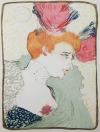 |
Bierbaum, Otto Julius, Julius Meier-Graefe u. a. (Red.). Pan. (Herausgegeben von der) Genossenschaft Pan. Erster (bis) Fünfter Jahrgang. 21 Hefte in 10 Bänden. Berlin, Verlag Pan 1895-1900. Folio (38 x 30 cm.). Mit 106 Originalgraphiken, 126 Tafeln, zwei Musikbeilagen und zahlreichen Textabbildungen sowie Buchschmuck. Orig.-Ledereinband mit goldgepr. Deckelvignette (Jahrgang 1896) und braune Halblederbände der Zeit mit blindgepr. Rückentiteln (illustr. Orig.-Umschläge beigebunden).
Dokumentations-Bibliothek I, 426. Schauer I, 20 ff. Schlawe I, 48 ff. Söhn HDO 525, 526–530. – Eines von 70 num. Exemplaren der Vorzugsausgabe auf Kupferdruck-Papier von E. Obst & Co., Strassburg und Berlin, die Tafeln meist auf Kaiserl. Japan von R. Wagner in Berlin. – Sehr gutes und vollständiges Exemplar mit allen Originalgraphiken, einschließlich der bedeutenden Farblithographie „Mad. Marcelle Lender en buste“ von Henri Toulouse-Lautrec. – Mit den farbigen Umschlägen mit dem Pan-Kopf nach Franz Stuck, allen Titelblättern und Inhaltsverzeichnissen. – „Die nach ihrer Ausstattung erlesenste deutsche Zeitschrift; ihr Hauptverdienst liegt in der Förderung der neuen Buchkunst, die im wesentlichen mit ihr in Deutschland beginnt. … Von den anderen literarischen Zeitschriften unterscheidet ‚Pan‘ besonders sein umgreifender Inhalt (Literatur und Kunst), sein buchkünstlerisches Wollen und seine Ausstattung“ (F. Schlawe). – Mit Originalgraphiken unter anderem von Peter Behrens, Otto Eckmann, Ludwig von Kalckreuth, Max Klinger, Käthe Kollwitz, Max Liebermann, Hans Olde, August Rodin, Paul Signac, Otto Ubbelohde und Henry van de Velde. – Dazu: Pan. Prospect-Buch. Inhalts- und Mitgliederverzeichnis der drei Jahre 1895, 1896, 1897 der Zeitschrift „Pan“. Berlin 1898. OKart. – Der Jahrgang 1896 vollständig auf Kaiserl. Japan gedruckt und im Orig.-Verlagseinband mit einer signierten Orig.-Lithographie von Franz Naager. – Der Ledereinband teils geringfügig berieben, die Deckel der Halblederbände und Schnitte etwas braunfleckig, sehr schönes Exemplar; alle Originalgraphiken alle fleckenfrei. Schlagwörter: Art nouveau, Deluxe edition, Edition de luxe, Jugendstil, Magazines, Nummerierte Bücher, Signierte Künstler-Graphik, Vorzugsausgaben, Zeitschriften |
18.000,-- | |
|
Einträge 1–7 von 7
Zurück · Vor
|
|||
| Seite: 1 |