



Geometry
Die Liste enthält 4 Einträge. Suchergebnisse löschen und Gesamtbestand anzeigen.
| Abbildung |
Beschreibung Gesamte Buchaufnahme |
Preis EUR |
|
|---|---|---|---|
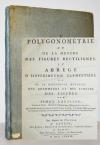 |
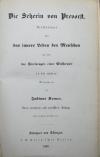
L’Huilier, Simon (Antoine Jean). Polygonométrie ou de la mesure des figures rectilignes. Et abrégé d’isoperimétrie élémentaire ou de la dépendance mutuelle des grandeurs et des limites des figures. Geneve, Barde, Manget & Compagnie et Paris, Buisson 1789. 4° (26 x 19 cm.). IV, 124 S. mit 2 gefalteten Kupfertafeln. Interims-Pappband der Zeit.
ADB XVIII, 529. DSB VIII, 307. Gottwald/Ilgauds/Schlote, Lexikon bedeutender Mathematiker 287 f. Poggendorff I, 1447. – Sehr seltene erste Ausgabe. – S. A. J. L’Huilier (1750-1840), Professor für Mathematik in Tübingen und später in Genf, „schrieb ausgezeichnete Lehrbücher der Analysis, Algebra und Geometrie. Er leitete elementar die Reihendarstellung der trigonometrischen Funktionen und der Exponentialfunktion her, bewies als erster konstruktiv die Existenz transzendenter Zahlen, arbeitete über Wahrscheinlichkeitsrechnung und stellte Inhaltsformeln für Polygone und Polyeder auf, wobei er die Analogien zwischen euklidischer und sphärischer Geometrie betonte. Die L’Huiliersche Formel der ebenen Geometrie verbindet den Inkreisradius eines Dreiecks mit den Ankreisradien. Die L’Huiliersche Formel der sphärischen Geometrie bestimmt den Exzess eines Dreiecks aus seinen Seiten analog zur Heronischen Formel für ebene Dreiecke“ (P. Schreiber in Gottwald/Ilgauds/Schlote). – „Im Uebrigen hatten L’Huilier’s Arbeiten hauptsächlich die Erweiterung und Vertiefung der heutzutage als Polygonometrie und Polyedrometrie bezeichneten Disciplinen zum Zwecke. Hierher sind zu rechnen die Schrift „De relatione mutua capacitatis et terminorum figurarum geometrice considerata“ (Varsoviae 1782), hierher die „Polygonométrie, ou de la mesure des figures rectilignes et abrégé d’isopérimetrie élémentaire“ (Genève 1789), hierher endlich ein Aufsatz in den Berliner Memoiren für 1781 über die Gestalt der Bienenzellen und ein solcher in Gergonne’s Annalen für 1812 über den Euler’schen Lehrsatz von den eckigen Körpern. L’Huilier’s Namen trägt jene überaus elegante Formel der sphärischen Trigonometrie, welche den Inhalt eines Kugeldreieckes als Function von dessen drei Seiten darzustellen lehrt. Sein bedeutendster Schüler war Sturm“ (Günther in ADB). – Rücken erneuert, Deckel etwas angestaubt, gutes sauberes Exemplar. Schlagwörter: Geodäsie, Geodesy, Geometrie, Geometry, Mathematics, Mathematik, Mathématiques |
400,-- |  |
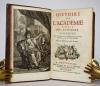 |
(Bouyer de Fontenelle, Bernard de, Editeur). Histoire de l’Académie Royale des Sciences. Année MDCCXIV. Avec les mémoires de mathématique & de physique pour la même année, tirés de registres de cette Académie. Amsterdam, Pierre de Coup (1719. Kl.-8° (16,3 x 10,2 cm.). [5] Bl., 571 S. mit Titel in Rot und Schwarz, gestoch. Frontispiz, gestoch. Titelvignette, 15 gefaltete Kupfertafeln und 1 gefaltete gestoch. Karte. Kalbslederband der Zeit mit goldgepr. Rückenschild, reicher Rückenvergoldung und Deckel-Filetten.
Zweiter Druck des Jahrgangs 1714 mit u. a. den wichtigen Beiträgen von Jacques Cassini „Des Réfractions Astronomiques.“ (Grundlegende Arbeit darüber, wie die Erdatmosphäre das Licht der Sterne bricht). – Giacomo Filippo Maraldi. „Observations du Changement qui est arrivé dans les Étoiles de la Constellation de la Baleine.“ (Beobachtung veränderlicher Sterne im Sternbild Walfisch). – Philippe de La Hire „Description d’une Machine pour élever de l’Eau.“ (Konstruktionsbeschreibung einer innovativen hydraulischen Wassermaschine). – René-Antoine Ferchault de Réaumur „Des effets que produit le Vigre [Vinaigre] sur des Matieres de differente nature.“ (Physikalisch-chemische Studien zur Ätzwirkung von Säuren auf Materialien). – Philippe de La Hire „Sur la Construction des Voûtes dans les Édifices.“ (Eine der ersten mathematisch-mechanischen Analysen zur Statik und Belastung von Gewölben in der Architektur). – Alexis Littré „Sur un Anévrisme vrai.“ (Pionierarbeit über die krankhafte Erweiterung von Blutgefäßen, ein medizinischer Meilenstein) sowie „Observations Anatomiques sur les parties de la Génération de l’Homme.“ (Anatomische Detailstudien). – Sehr schönes dekorativ gebundenes Exemplar. Schlagwörter: Astronomie, Astronomy, Chemie, Chemistry, Geometrie, Geometry, Medicine, Medizin, Physics, Physik, Zoologie, Zoology |
350,-- | |
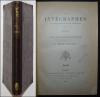 |
Abdank-Abakanowicz, Br(uno). Les intégraphes. La courbe intégrale et ses applications. Étude sur un nouveau système d’intégrateurs mécaniques. Paris, Gauthier-Villars 1886. Gr.-8°. X, 156 pp. avec 94 gravures sur bois dans le texte. Reliure originale demi-lin avec titre doré au dos (jaquette avant originale reliée).
Polski Slownik Biograficzny I, 1 f. Thomash/Williams A 1. – Erste Ausgabe. – Mit eigenhändiger Widmung von (inscribed by) B. Abdank-Abakanowicz „Hommage de l’autheur B. abdank-abakanowicz 5 place du Panthéon Paris“. – Eine deutsche Übersetzung von Emil Bitterli erschien 1889 in Leipzig. – „The integraph is a noteworthy development in the history of calculating instruments. While the principle on which it is based was introduced by Coriolis in 1836, it was in 1878 that Abdank-Abakanowitz first developed a practical working model. The integraph is an elaboration and extension of the planimeter, an earlier, simpler instrument used to measure area. It is a mechanical instrument capable of deriving the integral curve corresponding to a given curve. Hence, it is capable of solving graphically a simple differential equation. Sets of partial differential equations are commonly encountered in mathematical physics. Most branches of physics such as aerodynamics, electricity, acoustics, plasma physics, electron-physics and nuclear energy involve complex flows, motions and rates of change which maybe described mathematically by partial differential equations. A well-established example from electromagnetics is the set of partial differential equations known as Maxwell’s equations. In practice, differential equations can be difficult to integrate, that is to solve. The integraph is capable of solving only simple differential equations. The need to handle sets of more complex non-linear differential equations, led Vannevar Bush to develop the Differential Analyzer at MIT in the early 1930s. In turn, limitations in speed, capacity and accuracy of the Bush Differential Analyzer provided the impetus for the development of the ENIAC during World War II. Abdank-Abakanowicz’s instrument could produce solutions to a commonly encountered class of simple differential equations of the form dy/dx = F(x) so that y = ò F(x)dx. The basic approach was to draw a graph of the function F and then use the pointer on the device to trace the contour of the function. The value of the integral could then be read from the dials. The concept of the instrument was taken up and soon put into production by such well known instrument makers as the Swiss firm of Coradi in Zurich“ (E. Tomash). – Der polnische Mathematiker und Elektrotechniker B. Abdank-Abakanowicz (1852-1900) war nach seinem Ingenieur-Studium am Polytechnikum Riga Dozent für Mechanik in Lemberg. „Dort begann er seine Studien zur Planimetrie, die zum Bau des sog. Integrators führten, das zur zahlenmäßigen Darstellung von Infinitesimalrechnungen dient. Eine Beschreibung dieses mathematischen Instruments veröffentlichte Bruno Abakanowicz 1880 in „Rozprawy i Sprawozdania Wydzialu matematyczno-przyrodniczego Akademii Umiejetnosci w Krakowie“ sowie in der Warschauer Zeitschrift „Inzynierya i Budownictwo“. … Um 1880 erfanden er und der britische Physiker Sir Charles Vernon Boys unabhängig voneinander den Integraphen. 1881 siedelte Bruno Abakanowicz nach Paris um, wo er eine elektrotechnische Werkstatt errichtete. 1882 wurden schließlich noch drei Abhandlungen hierzu in den „Comptes rendus“ an der Pariser Akademie der Wissenschaften veröffentlicht. Kurze Zeit später wurde er zum Direktor der Betriebe der Compagnie française du procédé Thompson-Houston berufen. In diese Zeit fällt der Bau einer elektromagnetischen Klingel für Eisenbahnsignalanlagen sowie ein neuer Typ von elektrischen Lampen. Im Jahre 1889 übertrug ihm die französische Regierung die Leitung der Verhandlungen mit den USA bezüglich ihrer Teilnahme an der Weltausstellung Paris 1889. In demselben Jahr wurde ihm das Kreuz der Ehrenlegion verliehen“ (Wikipedia). – Rücken u. Kanten etwas berieben, mehrfach gestempelt (TH Wien, „Ausgeschieden“), das erste Bl. etwas gelockert, sehr gutes Exemplar. – The Polish mathematician and electrical engineer B. Abdank-Abakanowicz (1852-1900) was a lecturer in mechanics in Lviv after studying engineering at Riga Polytechnic. “There he began his studies on planimetry, which led to the construction of the so-called integrator, which is used for the numerical representation of infinitesimal calculations. Bruno Abakanowicz published a description of this mathematical instrument in 1880 in “Rozprawy i Sprawozdania Wydzialu matematyczno-przyrodniczego Akademii Umiejetnosci w Krakowie” and in the Warsaw journal “Inzynierya i Budownictwo”. … Around 1880, he and the British physicist Sir Charles Vernon Boys independently invented the integraph. In 1881 Bruno Abakanowicz moved to Paris, where he set up an electrotechnical workshop. In 1882, three papers on the subject were published in the “Comptes rendus” of the Paris Academy of Sciences. A short time later, he was appointed director of the operations of the Compagnie française du procédé Thompson-Houston. During this time, he built an electromagnetic bell for railroad signaling systems and a new type of electric lamp. In 1889, the French government put him in charge of negotiations with the USA regarding their participation in the 1889 Paris World’s Fair. In the same year, he was awarded the Cross of the Legion of Honor” (Wikipedia). – Spine and edges somewhat rubbed, stamped several times (TH Wien, “Ausgeschieden”), otherwise well preserved. Schlagwörter: Computer, Elektrotechnik, Geometrie, Geometry, Mathematics, Mathematik, Mathématiques, Mathematisches Instrument, Signierte Bücher, Widmungsexemplar |
500,-- | |
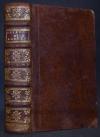 |
Barrême, N(icolas). L’arithmétique. Ou le livre facile pour apprendre l’arithmétique de soi-même, & sans maître. Nouvelle édition, augmentée de plus 190 pages… Paris, Gandouin e.a. 1788. Kl.-8°. xvi, 491, [81] p. avec title et frontisp. in gravure sur bois et quelques figures geometrique dans la texte. Ldr. d. Zt. mit goldgepr. Rückenschild u. reicher floraler Rückenverg.
Zuerst 1736 erschienenes erfolgreiches Lehrbuch. – Einband etwas berieben, eine Seite mit zeitgenöss. Anmerkungen im unteren w. Rand, hinterer Vorsatz mit handschr. Zahlentabellen, stellenweise leicht gebräunt u. leicht braunfl., gutes dekorativ gebundenes Exemplar. Schlagwörter: Arithmetic, Geometry, Mathematics, Mathematik, Mathématiques, Surveying |
60,-- | |
|
Einträge 1–4 von 4
Zurück · Vor
|
|||
| Seite: 1 |