



Phantastik / Utopie
Die Liste enthält 10 Einträge. Suchergebnisse löschen und Gesamtbestand anzeigen.
| Abbildung |
Beschreibung Gesamte Buchaufnahme |
Preis EUR |
|
|---|---|---|---|
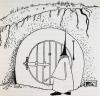 |
Tolkien, J(ohn) R(onald) R(euel). Kleiner Hobbit und der grosse Zauberer. (Aus dem Englischen übertragen von Walter Scherf). Recklinghausen, Paulus-Verlag (1957). 8°. 350 S. mit Illustrationen von Horus Engels. Illustrierter Orig.-Leinenband.
Vgl. LKJ III, 547 (dat. die erste Übersetzung falsch 1967). – Sehr seltene erste deutsche Ausgabe von „The Hobbit or there and back again“ (London 1937). Die vorliegende Übersetzung von W. Scherf (1920-2010) erschien erst 1971 als überarbeitete Neuausgabe mit dem Titel „Der kleine Hobbit“. 1992 erschien bei Klett-Cotta eine Neuübersetzung von Wolfgang Krege. Bereits 1938 verhandelte George Allen & Unwin mit dem Potsdamer Verlag Rütten & Loening über eine Übersetzung des Hobbit. Ein Vertrag kam jedoch nicht zustande, da Tolkien es ablehnte, den vom deutschen Verlag geforderten Ariernachweis zu liefern. – Der zwischen 1930 (oder 1931) und 1936 verfasste Fantasy-Roman für Kinder wurde weltweit über 100 Millionen Mal verkauft und in über 60 Sprachen übersetzt. – Mit kindgerechten zeittypischen Illustrationen des in London geborenen Malers, Illustrators und Bildhauers Horus Engels (eig. Richard E., 1914-1991). Engels hat bereits 1946 erste Entwürfe und einen Schutzumschlag-Entwurf direkt an J.R.R. Tolkien geschickt. Tolkien stand den Zeichnungen damals eher skeptisch gegenüber und kritisierte sie in Briefen an seinen Verlag als „zu sehr im Disney-Stil“ („too Disnified“). – Einband etwas angestaubt, sonst sehr gut erhaltenes sauberes Exemplar. Schlagwörter: Fantasy, Phantastik / Utopie |
1.200,-- |  |
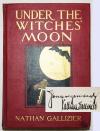 |
Gallizier, Nathan Under the Witches’ Moon. A romantic tale of mediaeval Rome. Boston, The Page Company 1917. 8°. VIII, [2], 455, [5], 10 pages with a colour frontispiece, an illustrated title page and 3 colour plates by Margaret West Kinney and Troy Sylvanus Kinney. Publisher’s decorated cloth with gold-embossed titles on the spine and front cover, and a front cover illustration in black, gold and red.
Bleiler, The Checklist of Fantastic Literature 122. Bleiler, The Guide to Supernatural Fiction 677. Nitka Collection of Fantastic Fiction (UCLA) 1605, Box 74. – First edition, first impression. – Signed by N. Gallizier. – The pilgrim Tristan of Avalon travels to the Eternal City to atone for his forbidden love for Hellayne – the wife of his feudal lord. Once there, however, Tristan quickly becomes entangled in a dense web of power struggles, passion and betrayal. He encounters the influential ‘Courtesan Queen of the Aventine’, is appointed commander of Castel Sant’Angelo by Senator Alberich, and must stand his ground against the sinister machinations of Grand Chamberlain Basil. – *Under the Witches’ Moon* marks the conclusion, or late climax, of a series of Gallizier’s novels set in Italy. He had previously explored similar themes in *The Sorceress of Rome* (1907) and *The Hill of Venus* (1913), all of which revolve around the ambivalence between Christian asceticism (pilgrimage) and worldly, often sinful passion. The book is a classic example of turn-of-the-century American historical romance. Unlike the European historical novel, which was often socially critical (as in the works of Walter Scott or Victor Hugo), the American trend of this period focused on escapism, melodrama and a rich atmosphere. Gallizier was known for combining meticulous historical research with highly imaginative, emotional tales of love and adventure. – Featuring beautiful Art Nouveau illustrations by the famous American artist couple Troy Kinney (1871–1938) and Margaret West Kinney (1872–1952), who were among the leading illustrators. As well as Nathan Gallizier’s lavish historical novels, they designed, amongst other things, book covers for Harper’s Bazaar magazine and illustrations for prominent authors such as Arthur Conan Doyle (for his historical novel *Sir Nigel*). Their shared passion was dance, which is why, in 1914, they wrote and illustrated the seminal work *The Dance: Its Place in Art and Life*, which remains well-known to this day. – The front cover has a small grease stain in the bottom right-hand corner, contemporary owner’s inscription in German (″Erhalten vom Autor am 15 August 1919 …“), a very good copy. Schlagwörter: Fantasie, Illustrated books, Illustrierte Bücher, Middle Ages, Mittelalter, Phantastik / Utopie, Rom, Signed books, Signierte Bücher, Trivial literature, Trivialliteratur, Trivialroman |
140,-- | |
 |
Clarke, Arthur C(harles). Prelude to space. London, Sidgwick and Jackson (1953). 8°. 176 p. Dark red original linen binding with a colour-illustrated dust jacket (by Gerard Quinn).
Currey p. 101. Samuelson A 3 c. – First UK edition and first hardcover edition, as compared with the first American edition of 1951 (as a paperback, New York, World Editions Inc.), with textual revisions. – Written in 1947, the novel follows a historian documenting the upcoming launch of Prometheus, the world’s first moonbound spacecraft. It is highly regarded by science fiction collectors for its accurate technological predictions, which heavily mirrored the actual Space Shuttle program decades later. – „Sir Arthur Charles Clarke was one of the most visionary minds of the 20th century—a rare figure who bridged the worlds of hard science and speculative fiction with equal mastery. Born on December 16, 1917, in the small seaside town of Minehead, England, Clarke’s fascination with the future began early. As a boy, he devoured American science fiction pulp magazines and built his first telescope from cardboard tubes, gazing at the moon with a longing that would define his life’s work. … As a writer, Clarke’s career soared with the 1951 publication of Childhood’s End, a novel that explored human evolution and cosmic transcendence. His true masterpiece arrived in 1968: 2001: A Space Odyssey, which he developed in parallel with Stanley Kubrick’s landmark film. Both the novel and the film redefined science fiction, presenting a realistic, awe-inspiring vision of humanity’s journey into the cosmos“ (L. W. Currey). – The dust jacket has small areas missing from the top edge and is slightly scuffed, but is otherwise in very good condition. Schlagwörter: Fantasy, Phantastik / Utopie, Raumfahrt, Science Fiction |
350,-- | |
 |
Clarke, Arthur C(harles). 2001, a space odyssey. A novel, based on the screenplay by Stanley Kubrick and Arthur C. Clarke. London, Hutchinson of London (1968). 8°. 224 p. Publisher’s hardcover with a colour-illustrated dust jacket (designed by Michael Brett).
Currey 92. Samuelson A21. – First UK edition. Published in June 1968, at the same time as the American edition (New York, The New American Library), just a few weeks after the film’s UK cinema release in May 1968. Arthur C. Clarke himself noted in his memoirs (The Lost Worlds of 2001) that Stanley Kubrick’s final approval of the book manuscript had delayed its publication until the summer of that year. – The front of the dust jacket features the actor Keir Dullea as Dr David Bowman. The back shows the spaceship Discovery. – The story is based in part on various short stories by Clarke, including „The Sentinel“ (written in 1948 for a BBC competition, but first published in 1951 under the title „Sentinel of Eternity“). The first part of the novel, in which aliens influence the primitive ancestors of humans, is similar to the plot of Clarke’s 1953 short story „Encounter in the Dawn“. – „The novel has very little of the poetry of the picture“ and „lacks most of the picture’s strengths“, but that „it has to be read before one can understand the picture“ (James Blish, The Future in Books, 1969, p. 141 f.). – „And, of course, it is a fantasy—you need not believe it—but a fantasy by a master who is as deft at generating accelerating, almost painful suspense as he is knowledgeable and accurate (and fascinating) about the technical and human details of space flight and exploration. But it is finally the stretching of the imagination that is most enthralling as Mr. Clarke entices the reader into strange and magnificent conceptions of other forms of time, dimension and existence“ (Eliot Fremont-Smith, New York Times, July 5, 1968). – The dust jacket has minor tears at the edges; a fine copy. Schlagwörter: Fantasy, Phantastik / Utopie, Science Fiction |
650,-- | |
 |
Hofbauer, Ludwig. Der Pestkrieg. Ein Zukunftsroman. Regensburg, Ludwig Rath 1927. 8°. 350 S., [1] Bl. Orig.-Leinenband.
Bloch 2/1502. – Erste Ausgabe. – Von L. Hofbauer auf dem Vortitel signiert „L. Hofbauer, Schwandorf i. Bayern“. -Science-Fiction- und Katastrophenroman; Eine geheime asiatische und amerikanische Organisation versucht, mithilfe von künstlich gezüchteten Pestkulturen die Weltherrschaft zu erringen. Bevor die Seuche eingedämmt werden kann, fallen Hunderttausende Menschen dem biologischen Krieg zum Opfer. Am Ende steht der utopische beziehungsweise dystopische Neuanfang einer vermeintlich gestärkten Gesellschaft. – Der Roman gilt in der Karl-May-Forschung als vermeintliche Quelle für die reale Existenz Winnetous; Ludwig Hofbauer schreibt S. 82, Winnetou sei keine reine Phantasiegestalt, sondern eine historisch reale Person gewesen: „Mein Großvater hatte als Häuptling der Apachen in den Bergen des Westens einen guten Namen. Sie haben von Winnetou, dem großen Häuptling, gehört. Ein Deutscher hat vor Jahrzehnten viel von ihm geschrieben…“ – Hofbauer „stützt sich dabei auf historische Briefe des deutschen Auswanderers Fritz Saul aus den Jahren 1869/1870. Saul schrieb damals aus Nordamerika an seinen Bruder in Deutschland und behauptete, den echten Apachenhäuptling Winnetou im Südwesten der USA persönlich gekannt zu haben. Da Karl Mays erster großer Winnetou-Roman erst 1893 erschien, löste diese Erwähnung in einem Dokument aus dem Jahr 1869 unter Karl-May-Anhängern eine Sensation aus. Es entstand kurzzeitig die Theorie, Karl May habe seine Figur nach einem realen Vorbild geformt oder alte Reiseberichte als Quelle genutzt. Der Karl May Verleger E. A. Schmid veröffentlichte im Karl-May-Jahrbuch 1929 die Ergebnisse der Nachforschungen, demnach hatte Fritz Saul sich wohl geirrt. Er hatte in Arizona sehr wahrscheinlich mit dem realen Apachen-Häuptling Chief Victorio zu tun (dem Nachfolger von Cochise) und brachte diesen Jahrzehnte später fälschlicherweise mit Karl Mays berühmter Romanfigur in Verbindung. Winnetou bleibt somit eine reine Erfindung Karl Mays. Hofbauers „Pestkrieg“ ging dadurch jedoch als eines der kuriosesten Fundstücke in die literaturwissenschaftliche Geschichte der Karl-May-Forschung ein“ (Karl-May Gesellschaft). – Rücken etwas berieben, Deckel leicht fleckig, sonst gut erhalten. Schlagwörter: Phantastik / Utopie, Phantastische Literatur, Signed books, Signierte Bücher |
70,-- | |
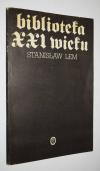 |
Lem, Stanislaw. Biblioteka XXI wieku (polnisch, Bibliothek des 21. Jahrhunderts). Kraków (Krakau), Wydawn. Literackie (1986). 8°. 105, (6) S. Orig.-Kartonumschlag.
Seltene erste Ausgabe. – „Die „Bibliothek des 21. Jahrhunderts“ ist eine Sammlung fiktiver Rezensionen und Einleitungen zu nicht existierenden Büchern, in der der Autor zunächst meisterhaft zeitgenössische literarische Stile parodiert, um sich anschließend in das Abenteuer der Schaffung apokrypher Konzepte von Welt und Mensch zu stürzen, die in das Reich endlos sprudelnder Texte und – manchmal verrückter – Ideen vordringen. Diese Ideen gleiten mal in groteske Absurdität ab – mal erweisen sie sich als scharfsinnige Prognose für zukünftige Zustände unserer Zivilisation“ (solaris(dot)lem(dot)pl, übersetzt aus dem polnischen). – „Ich glaube, dass mit den Jahren meine Ungeduld gegenüber der gewissenhaften, handwerklichen und langsamen Ausarbeitung einer Geschichte immer größer wurde. Um die Erleuchtung einer Idee in eine Erzählung zu verwandeln, muss man sich furchtbar abmühen, und zwar in einer Weise, die über das Intellektuelle hinausgeht. Das war einer der Hauptgründe, warum ich so grausame Abkürzungen genommen habe, wie sie diese Bücher waren. In diesen Büchern habe ich versucht, verschiedene Stile nachzuahmen: den Stil einer Rezension, eines Vortrags, einer Rede, einer Dankesrede (eines Nobelpreisträgers) und dergleichen. Diese Erfahrungen sind wie „Kisten“, die, übereinandergestapelt, eine Treppe bilden, über die ich in das Stockwerk geklettert bin, von dem aus der Golem spricht“ (S. Lem). – Gelenke, Kapital und Fuß leicht berieben, sehr gutes Exemplar. Schlagwörter: Bibliographie, Bibliography, Imaginary books and libraries, Phantastik / Utopie, Science Fiction, Technology and civilization |
140,-- | |
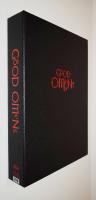 |
Pratchett, Terry and Neil Gaiman. Good omens. The nice and accurate prophecies of Agnes Nutter, witch. Illustrated with line drawings and colour plates by Paul Kidby. London, Dunmanifestin (2019). Gr.-4° (31 x 23,7 cm.). 278 S. mit 20 Farbtafeln und Illustrationen von Paul Kidby. Illustr. Orig.-Pappband in Buch-Kassette in Schlangenleder-Optik.
Eines von 1655 num. Exemplaren; von Paul Kidby signiert. – One of 1655 limited copies. Stunning collectors’ hardback in a snakeskin effect solander box, with metallic red page edges, 20 colour illustrations with additional pencil illustrations. Numbered tipped-in sheet signed by Paul Kidby. – „Working with Terry was a life-enriching experience for me, both professionally and personally. He had so much to say and do, books to write, orang-utans to save, campaigns to wage. His creative energy was irrepressible, always questing and dynamic – brimming over with ideas and plots that needed pinning down. Never one to sit back, Terry had so much that he wanted to achieve, and in the final years, as he was all too aware, there just wasn’t enough time. If I could speak to Terry again, I’d thank him for writing the books that are my greatest source of creative inspiration, and for the belief and encouragement he showed by giving me the fantastic opportunity to illustrate his writing. I’d thank him for the laughs and friendship we shared too. I remember snippets of our conversations about folklore, astronomy, gardening and recipes for nettle soup. We shared an affinity for the chalk downlands where we both lived for a time, the landscape seemed to exert a creative energy for us both. My dog and I tramped many of the ancient drove roads that traverse the grassy backbone of the downs, I knew well the wide skies, the far-reaching views and the leaping hare that he described. Blue butterflies, skylarks, soaring buzzards and harebells in the close-cropped turf were all observed on my walks, and many a flint and fossil weighted my pockets – including the shepherd’s crown“ (Paul Kidby). Schlagwörter: Fantasy, Illustrated books, Illustrierte Bücher, Nummerierte Bücher, Phantastik / Utopie, Signed books, Signierte Bücher, Vorzugsausgaben |
500,-- | |
 |
Tolkien, J(ohn) R(onald) R(euel). The lord of the rings. I. The fellowship of the ring. – II. The two towers. – III. The return of the king. Second edition, fourth (and) third (III) impression. 3 volumes. London, Allen & Unwin (1968-1869). 8°. 423, (1) p.; 352 p.; 440 p. with 3 folded maps in black and red. Original dark red cloth, gilt lettered spines and illustrated dustjackets.
LKJ III, 547 f. – Eine der letzten Ausgaben in 1960er Jahren; die erste deutsche Übersetzung erschien ebenfalls erst 1969 bis 1970. – „In „Lord of the rings“ drückt sich eine Abneigung gegen die moderne Gesellschaft und eine Sehnsucht nach vorindustriellen Zuständen aus. So wird T. auch von seiner derzeit größten Anhängerschar, den Jugendlichen, begriffen, die ihren Überdruß am Bestehenden und ihre Sehnsucht nach Neuem von H. HESSE und T. am besten dargestellt sehen“ (W. Neumann in LKJ). – Schutzumschlag von Band III an den Gelenken geringfügig berieben, sehr gutes Exemplar. Schlagwörter: Fantasy, Phantastik / Utopie, Phantastische Literatur |
750,-- | |
 |
Borges, Jorge Luis (Hrsg.). Meisterwerke der Phantastischen Weltliteratur. (Sonderausgabe der Edition Weitbrecht). 15 Bände. Stuttgart, Thienemanns Verlag (ca. 1983). Gr.-8°. Ca. 4000 S. mit zahlr. Illustrationen von Aubrey Bearsdsley. Schwarz-weiß illustr. Orig.-Pappbände.
Neuwertiges Exemplar. Schlagwörter: Fantasie, Fantastik, Horror, Phantastik / Utopie |
100,-- | |
 |
Brjussoff (Brjusov), Valerij (Jakovlevic). Die Republik des Südkreuzes. Novellen. „Dieses Exemplar gehört zur 2. Auflage.“ München, Hans von Weber 1908. Gr.-8°. 108 S., [1] Bl. OPbd. mit goldgepr. Rücken- und Deckeltitel und goldgepr. Deckelillustration.
Hayn/G. I, 472. KNLL III, 190. – Erste deutsche Ausgabe. – Als 2. Auflage bezeichnete Normalausgabe, neben der gleichzeitig erschienen Vorzugsausgabe in 50 Exemplaren. – Die russische Originalausgabe erschien 1905 in Moskau. – Die dystopische Titelgeschichte schildert den Zusammenbruch einer fiktiven Wohlfahrtsdiktatur in der Antarktis. – „Mit Vergewaltigung, Mord, Raub, Menschenfresserei und Totschlag richtet sich das Volk in einem letzten Bacchanal der Grausamkeiten und sexuellen Exzesse selbst zugrund“. Brjussovs Zivilisationskritik geht „von Nietzsches Kategorie des Dionysischen aus, das die ‚dünne, obgleich jahrtausendealte Rinde‘ der Kultur durchbricht“ (KNLL III, 190). – Enthält außerdem die Novellen: „Die Schwestern“, „Im unterirdischen Kerker“, „Die letzten Märtyrer“, „Jetzt wo ich erwacht bin“, „Im Spiegel“ und „Das Köpfchen aus Marmor“. – V. J. Brjusov (1873-1924), Begründer des russischen Symbolismus, „trat 1920 im Gegensatz zu den anderen Symbolisten der Kommunistischen Partei bei. In verschiedenen Positionen künstlerischer Institutionen vor allem organisatorisch tätig, begründete er 1921 die Hochschule für Literatur und Kunst“ (Wikipedia). – „(W)enn Brjussof nicht so selbständig wäre, [könnte man] ihn gern den russichen Poe oder Hoffmann nennen“ (Aus dem Verlagsprospekt, zitiert nach Hayn/Gotendorf). – Sehr gutes sauberes Exemplar. Schlagwörter: Phantastik / Utopie, Phantastische Literatur, Utopie |
120,-- | |
|
Einträge 1–10 von 10
Zurück · Vor
|
|||
| Seite: 1 |