



Science Fiction
Die Liste enthält 6 Einträge. Suchergebnisse löschen und Gesamtbestand anzeigen.
| Abbildung |
Beschreibung Gesamte Buchaufnahme |
Preis EUR |
|
|---|---|---|---|
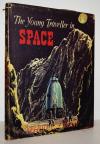 |
Clarke, Arthur C(harles). The young traveller in space. London, Phoenix House (1954). 4°. (25,5 x 19 cm.). 72 p. with 1 colour plate (frontispice, by R. A. Smith), 31 monochrome plates and 6 diagrams. Colour-illustrated hardcover with a colour-illustrated dust jacket (by Edmund Louis Blandford).
Currey 135282. Samuelson A 14 a. – Erste Ausgabe des frühen britischen Werks, welches jungen Lesern auf leicht verständliche Weise die Grundlagen der Raketentechnik, die Geschichte des astronomischen Denkens sowie Clarkes Visionen über zukünftige Reisen zum Mond und zu anderen Planeten vermittelt. Der berühmten britischen Science-Fiction-Autor und Zukunftsforscher Arthur C. Clarke (1917-2008) war in den 1950er Jahren Vorsitzender der British Interplanetary Society. – Die Tafeln zeigen: „artificial satellite or space-station“, einen Kupferstich des 18. Jahrhunderts „The first imaginary spaceship, how Cyrano de Bergerac visualized space-travel“, Szenen aus den Hollywood-Filmen „Destination Moon“ und „When Worlds Collide“, Portraits von Hermann Oberth, Robert Goddard und Wernher von Braun, die V 2 Rakete, Filmaufnahmen von zwei Mäusen im Weltraum u. a. – Schutzumschlag mit kleinen Randläsuren, sehr gutes Exemplar. Schlagwörter: Raketen, Raketentechnik, Raumfahrt, Science Fiction, Space travel, Technik |
320,-- |  |
 |
Clarke, Arthur C(harles). Prelude to space. London, Sidgwick and Jackson (1953). 8°. 176 p. Dark red original linen binding with a colour-illustrated dust jacket (by Gerard Quinn).
Currey p. 101. Samuelson A 3 c. – First UK edition and first hardcover edition, as compared with the first American edition of 1951 (as a paperback, New York, World Editions Inc.), with textual revisions. – Written in 1947, the novel follows a historian documenting the upcoming launch of Prometheus, the world’s first moonbound spacecraft. It is highly regarded by science fiction collectors for its accurate technological predictions, which heavily mirrored the actual Space Shuttle program decades later. – „Sir Arthur Charles Clarke was one of the most visionary minds of the 20th century—a rare figure who bridged the worlds of hard science and speculative fiction with equal mastery. Born on December 16, 1917, in the small seaside town of Minehead, England, Clarke’s fascination with the future began early. As a boy, he devoured American science fiction pulp magazines and built his first telescope from cardboard tubes, gazing at the moon with a longing that would define his life’s work. … As a writer, Clarke’s career soared with the 1951 publication of Childhood’s End, a novel that explored human evolution and cosmic transcendence. His true masterpiece arrived in 1968: 2001: A Space Odyssey, which he developed in parallel with Stanley Kubrick’s landmark film. Both the novel and the film redefined science fiction, presenting a realistic, awe-inspiring vision of humanity’s journey into the cosmos“ (L. W. Currey). – The dust jacket has small areas missing from the top edge and is slightly scuffed, but is otherwise in very good condition. Schlagwörter: Fantasy, Phantastik / Utopie, Raumfahrt, Science Fiction |
350,-- | |
 |
Clarke, Arthur C(harles). 2001, a space odyssey. A novel, based on the screenplay by Stanley Kubrick and Arthur C. Clarke. London, Hutchinson of London (1968). 8°. 224 p. Publisher’s hardcover with a colour-illustrated dust jacket (designed by Michael Brett).
Currey 92. Samuelson A21. – First UK edition. Published in June 1968, at the same time as the American edition (New York, The New American Library), just a few weeks after the film’s UK cinema release in May 1968. Arthur C. Clarke himself noted in his memoirs (The Lost Worlds of 2001) that Stanley Kubrick’s final approval of the book manuscript had delayed its publication until the summer of that year. – The front of the dust jacket features the actor Keir Dullea as Dr David Bowman. The back shows the spaceship Discovery. – The story is based in part on various short stories by Clarke, including „The Sentinel“ (written in 1948 for a BBC competition, but first published in 1951 under the title „Sentinel of Eternity“). The first part of the novel, in which aliens influence the primitive ancestors of humans, is similar to the plot of Clarke’s 1953 short story „Encounter in the Dawn“. – „The novel has very little of the poetry of the picture“ and „lacks most of the picture’s strengths“, but that „it has to be read before one can understand the picture“ (James Blish, The Future in Books, 1969, p. 141 f.). – „And, of course, it is a fantasy—you need not believe it—but a fantasy by a master who is as deft at generating accelerating, almost painful suspense as he is knowledgeable and accurate (and fascinating) about the technical and human details of space flight and exploration. But it is finally the stretching of the imagination that is most enthralling as Mr. Clarke entices the reader into strange and magnificent conceptions of other forms of time, dimension and existence“ (Eliot Fremont-Smith, New York Times, July 5, 1968). – The dust jacket has minor tears at the edges; a fine copy. Schlagwörter: Fantasy, Phantastik / Utopie, Science Fiction |
650,-- | |
 |
Lem, Stanislaw. Biblioteka XXI wieku (polnisch, Bibliothek des 21. Jahrhunderts). Kraków (Krakau), Wydawn. Literackie (1986). 8°. 105, (6) S. Orig.-Kartonumschlag.
Seltene erste Ausgabe. – „Die „Bibliothek des 21. Jahrhunderts“ ist eine Sammlung fiktiver Rezensionen und Einleitungen zu nicht existierenden Büchern, in der der Autor zunächst meisterhaft zeitgenössische literarische Stile parodiert, um sich anschließend in das Abenteuer der Schaffung apokrypher Konzepte von Welt und Mensch zu stürzen, die in das Reich endlos sprudelnder Texte und – manchmal verrückter – Ideen vordringen. Diese Ideen gleiten mal in groteske Absurdität ab – mal erweisen sie sich als scharfsinnige Prognose für zukünftige Zustände unserer Zivilisation“ (solaris(dot)lem(dot)pl, übersetzt aus dem polnischen). – „Ich glaube, dass mit den Jahren meine Ungeduld gegenüber der gewissenhaften, handwerklichen und langsamen Ausarbeitung einer Geschichte immer größer wurde. Um die Erleuchtung einer Idee in eine Erzählung zu verwandeln, muss man sich furchtbar abmühen, und zwar in einer Weise, die über das Intellektuelle hinausgeht. Das war einer der Hauptgründe, warum ich so grausame Abkürzungen genommen habe, wie sie diese Bücher waren. In diesen Büchern habe ich versucht, verschiedene Stile nachzuahmen: den Stil einer Rezension, eines Vortrags, einer Rede, einer Dankesrede (eines Nobelpreisträgers) und dergleichen. Diese Erfahrungen sind wie „Kisten“, die, übereinandergestapelt, eine Treppe bilden, über die ich in das Stockwerk geklettert bin, von dem aus der Golem spricht“ (S. Lem). – Gelenke, Kapital und Fuß leicht berieben, sehr gutes Exemplar. Schlagwörter: Bibliographie, Bibliography, Imaginary books and libraries, Phantastik / Utopie, Science Fiction, Technology and civilization |
140,-- | |
 |
Harbou, Thea (Gabriele) v. Metropolis. Roman. Berlin, August Scherl (1926). 8°. 273, (1) S., [3] Bl. Orig.-Leinenband mit goldgepr. Rücken- und Deckeltitel, Rückenvergoldung und farbig illustr. Schutzumschlag von W(ilhelm Albert Walter) Reimann.
Barron 3-23. Bleiler, Science-Fiction 1940. Holstein S. 211 (kart. Ausgabe). Kosch VII, 318 f. NDB VII, 645 f. Rössler, Filmfieber S. 116. – Erste Ausgabe. – T. G. v. Harbou (1888-1954) „verzichtete in ihren Romanen auf Psychologie und Charakterzeichnung zugunsten einer schwülstig pathetischen Seelenschilderung und eines packenden Handlungsablaufes. – Wesentlich ist ihre Arbeit als Drehbuchautorin. Der zum Monumentalen neigende, teils architektonisch strenge, teils phantastische und legendenhafte Stil der Stummfilme Fritz Langs ist von ihr entscheidend mitbestimmt worden. … Ihre hervorragende Begabung, eine Handlung in die Bildersprache des Films zu übersetzen, erweist sich besonders bei der Bearbeitung literarischer Werke. … H. hat einen wesentlichen Einfluß auf die Entwicklung des deutschen Films ausgeübt, sie ist keineswegs nur eine vielbeschäftigte Routineschreiberin“ (R. Burgmer in NDB). – Mit dem seltenen Schutzumschlag des Malers, Filmarchitekten und Drehbuchautors W. A. W. Reimann (1887-1936), der bereits 1919 die Kulissen und Kostüme für den expressionistischen Film-Klassiker „Das Cabinet des Dr. Caligari“ entworfen hat. – Der Schutzumschlag am Kapital unauffällig restauriert und an den Kanten geringf. berieben, außergewöhnlich schönes und sauberes Exemplar. – The dust jacket unobtrusively restored at the spine and slightly rubbed at the edges, an exceptionally nice and clean copy. Schlagwörter: Expressionismus, Film, Pop-Kultur, Science Fiction |
4.500,-- | |
 |
Lapointe, Tanya. Hinter den Kulissen von Dune. 1. Auflage. Stuttgart, Panini Books Oktober 2021. 4°. 239 S. mit zahlr. farb. Abb. Farb. illustr. OPbd. in farb. illustr. Orig.-Pappschuber.
Sehr gutes Exemplar. Schlagwörter: Science Fiction |
40,-- | |
|
Einträge 1–6 von 6
Zurück · Vor
|
|||
| Seite: 1 |