



Konstruktivismus
Die Liste enthält 5 Einträge. Suchergebnisse löschen und Gesamtbestand anzeigen.
| Abbildung |
Beschreibung Gesamte Buchaufnahme |
Preis EUR |
|
|---|---|---|---|
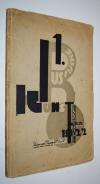 |
Lissitzky – Holitscher, Arthur, Edwin Redslob und David Sterenberg (Vorworte). Erste Russische Kunstausstellung, Berlin 1922. Galerie van Diemen. Berlin, Verlag Internationale Arbeiterhilfe 1922. Gr.-8° (23 x 14,5 cm.). 31 S. und 54 Abbildungen auf 23 Tafeln. Typographisch gestalteter Orig.-Kartonumschlag (von El Lissitzky).
Bolliger, Dokumentations-Bibliothek III, 20 und VI, 677. Lissitzky-Küppers S. 5 f. und Tafel 65 (Entwurf des Umschlags). Rowell/Wye 404 und S. 197. – Katalog der ersten Kunstausstellung der russischen Avantgarde in Westeuropa. Mit einem Verzeichnis der 593 Exponate u. a. von Altman, Burljuk, Chagall, Gabo, Iwanow, Lissitzky, Malewitsch, Pevsner, Puni, Rodtschenko, Rosanova, D. Sterenberg, Tatlin. – „Der Beauftragte des Volkskommissariat für Bildung und Kunst schreibt im Vorwort des Katalogs „Mit dieser Einführung verfolgen wir den Zweck, Westeuropa alles zu zeigen, was geeignet ist, über die schöpferischen Errungenschaften der russischen Kunst in den Kriegs- und Revolutionsjahren Aufschluss zu geben…“.“ (Hans Bolliger). – Rücken und Gelenke etwas berieben, Umschlag angestaubt und leicht braunfleckig, sonst sehr gut erhalten. Schlagwörter: Avantgarde, Constructivism, Expressionisme, Expressionismus, Konstruktivismus |
1.600,-- |  |
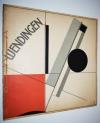 |
Lissitzky – Wijdeveld, H. Zh. (Ed.). Wendingen. (No.) 11 (Special issue: Frank Lloyd Wright). Amsterdam 1921. 4° (33,5 x 33,5 cm). 38 p. with 22 partly full-page illustrations. Colour illustrated original cardboard cover (bound as a block book and fastened with raffia cord).
Heiting, Dutch Photo Publications S. 62 ff. Katalog Kurt Schwitters Merzgebiete, S. 142 (mit farb. Abb.). Lissitzky-Küppers Abb. 70. Nisbet 1922/15. Rowell/Wye 346 (mit Abb. S. 196). – One of seven issues of the art and architecture magazine dedicated to Frank Lloyd Wright, featuring the famous constructivist colour lithograph by El Lissitzky, which ranks among his major works in terms of book design. – Text by H. P. Berlage. – „Each issue had six plates… The goal was to illustrate the current developments in the arts as related to architecture. This was made possible by photolithography. This new technique avoided the necessity of copying images first onto lithographic stones by hand, thus saving time. Another big advantage was that the plates would show reality. However, the reproduction of photo’s required special quality, and thus costlier, paper to print on as otherwise the ink would not dry quickly enough and might blur the image. … From 1921 onwards, every issue was to be devoted to just one topic, as by then the text had become a photobook on the subject. The American architect Frank Lloyd Wright (1867-1959) was the hero of the group „Wendingen“ as well as of of the group „de Stijl“.Wijdeveld dedicated a special issue to Wright’s work in 1922 and had Russian architect and designer El Lissitzky (1880-1941) design the cover, depicting the cosmos. Thatthe design also had undertones of Bolshevik propaganda was masked by an alternation of the design: the red sun (inspiring communism) was blackened. Today, Wendingen’s fame is mostly derivated from this important single issue“ (M. Le Coultre in Heiting, Dutch Photo Publications). – Spine slightly rubbed, cover slightly dusty at the edges, small bookplate on the title page, fine copy. Schlagwörter: Architectural photography, Architecture, Architekturfotografie, Architekturphotographie, Avantgarde, Konstruktivismus, Kunst, Magazines, Photographie, Zeitschriften |
2.400,-- | |
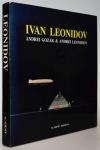 |
Leonidov – Gozak, Andrei and Andrei Leonidov. Ivan (Iljitsch) Leonidov. The complete Works. Edited and designed by Catherine Cooke. Photography by Igor Palmin. London, Academy Editions (1988). 4°. 216 S. mit zahlr. teils farb. Abbildungen. Orig.-Leinenband mit silbergepr. Rücken- und Deckeltitel und farbig illustr. Schutzumschlag.
Erste Ausgabe. – Werkverzeichnis des bedeutenden russischen konstruktivistischen Architekten und Städteplaners I. I. Leonidov (1902-1959), der vor allem für seine unverwirklichten architektonischen Projekte, besonders seinen Entwurf von 1927 für das Lenin-Institut in Moskau, bekannt ist. Seine Werke zählen zu den Höchstleistungen der Architektur seiner Zeit. – Sehr gutes Exemplar. – First edition. – Catalogue raisonné of the important Russian constructivist architect and urban planner I. I. Leonidov (1902-1959), who is best known for his unrealised architectural projects, particularly his 1927 design for the Lenin Institute in Moscow. His works are among the finest achievements of the architecture of his time. – Fine copy. Schlagwörter: Avantgarde, Catalogue raisonné, Catalogues raisonnés, Konstruktivismus, Werkverzeichnis, Werkverzeichnisse |
140,-- | |
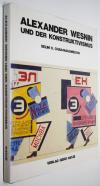 |
Wesnin – Chan-Magomedov, Selim Omarovic. Alexander Wesnin und der Konstruktivismus. (Übersetzung aus dem Französischen von Bettina Aldor). Stuttgart, Gerd Hatje (1987). 219 S. mit teils farb. Abb. Orig.-Leinenband mit farbig illustr. Schutzumschlag.
Erste deutsche Ausgabe. – Sehr gutes Exemplar. Schlagwörter: Architektur, Avantgarde, Konstruktivismus |
30,-- | |
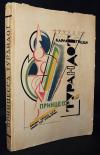 |
Nivinsky – (Gozzi, Carlo). Prinzessa Turandot. Tragiko-theatralisches chinesisches Märchen in 5 Akten (russisch). Moskau und Petrograd, Gos, Izdat (1923). Gr.-4° (33,2 x 24,8 cm.). 222 S., [1] Bl. mit 12 Farblithographien und zahlreichen Vignetten von Ignatius Ignatjewitsch Nivinsky sowie 14 Zinkographien und zahlreichen Abbildungen nach Fotografien. Farbig illustr. Orig.-Kartonumschlag.
Bowlt/Hernad 75. Compton S. 158. Hellyer 134. Rowell/Wye 493. – Erste Ausgabe. – Ausführliche Dokumentation zur legendären Turandot-Aufführung durch das 3. Studio des Moskauer Akademischen Theaters unter der Regie von Evgeny Vakhtangov (Wachtangow). – „In 1923 a commemorative volume was devoted to Vakhtangov’s colourful production of Carlo Gozzi’s Princess Turandot for the Third Studio of the Moscow Arts Theatre. Unfortunately he died of illness without seeing the production, which he directed from his hospital bed. Costumes and decor were by Ignaty Nivinsky who was also responsable for the book, providing a cubistic design for the cover, printed in pastel shades of yellow, blue, pink and green. The publication, which includes colour plates as well as photographs, gives an idea of the look of the production“ (Susan Compton, Russian Avant-Garde Books). – Das Gedenkbuch für den im Jahr der Aufführung verstorbenen Theater-Leiter Jewgeni Bagrationowitsch Wachtangow (1883-1922) enthält Texte zur Inszenierung, der Geschichte des Theaters und zu den künstlerischen Auffassungen Wachtangows sowie Text und die Partitur des Märchenspiels. – Die Farblithographien zeigen Niwinskis expressive Bühnenbilder und Figurinen, die Schauspielerporträts teils mit transparenten Vorblättern mit von ihm entworfenen konstruktivistischen Vignetten. Von Ignaz Niwinsky, der 1921 bis 1930 Lehrer an den berühmten WChUTEMAS-Werkstätten war, stammt die gesamte Buchgestaltung inklusive der konstruktivistische Umschlaglithographie. – Der bedeutende russische Maler, Zeichner, Grafiker, Architekt und Bühnenbildner Ignatius Ignatjewitsch Nivinsky (1880-1933) arbeitete seit 1910 besonders als Monumental- und Dekorationsmaler in Moskau und entwarf auch das Mausoleum Lenins. Als Architekt arbeitete Nivinsky mit dem Jugendstil-Architekten Valentin Dubovski zusammen und entwickelte einen neuen Bautypus. Seit 1912 lebte und arbeitete er in seinem von ihm selbst entworfenen Atelier, das sich zum Treffpunkt der kulturellen Elite Moskaus entwickelte und wo Nivinsky Ausstellungen, Lesungen und Musikabende veranstaltete. In den 20er Jahren war Nivinsky Leiter der Dekorationswerkstätten des Mali-Theaters. – Umschlag mit geringen Randläsuren und etwas gebräunt, Rücken am Kapital und Fuss unauffällig restauriert, Tafelränder teils etwas braunfleckig, papierbedingt leicht gebräunt, sehr gutes Exemplar und sehr selten!. Schlagwörter: Avantgarde, Expressionismus, Illustrated books, Illustrierte Bücher, Konstruktivismus, Kubismus, Märchen, Theater |
1.600,-- | |
|
Einträge 1–5 von 5
Zurück · Vor
|
|||
| Seite: 1 |