




Livingstone, Missionary travels and researches in South Africa
Livingstone, Missionary travels and researches in South Africa
|
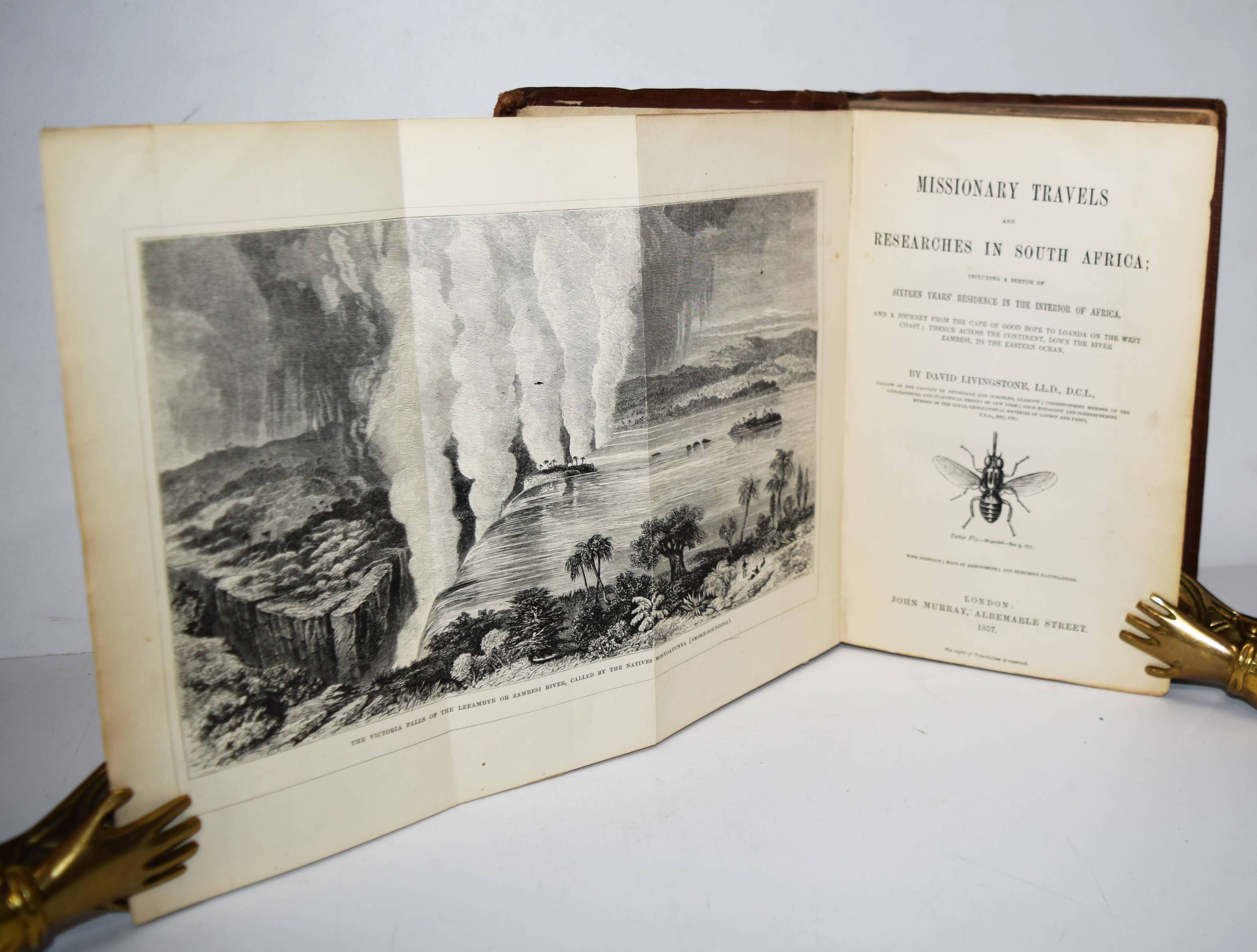
Livingstone, David. Missionary travels and researches in South Africa. Including a sketch of sixteen years’ residence in the interior of Africa, and a journey from the Cape of Good Hope to Loanda on the West Coast; thence across the continent, down the river Zambesi, to the Eastern Ocean. London, John Murray 1857. Gr.-8° (23 x 15,5 cm.). IX, 687, (1), 8 S. (Verlagswerbung dat. 1. Nov. 1857) mit gefalt. Holzstich-Frontispiz, gestoch. Portrait, zahlreichen Holzstichen im Text und auf (1 gefalt.) Tafeln, 2 gefalt. lithogr. Karten (davon 1 in Rückentasche) und 1 gefalt. lithogr. Plan (Höhenprofil). Bindgepr. Orig.-Leinenband mit goldgepr. Rückentitel. Abbey, Travel 347. Bradlow, Africana books and pictures 123. Embacher 190. Gay 3034. Henze III, 270. Mendelssohn III, 136. PMM 341 a. Vgl. Kainbacher 247 (deutsche Übersetzung). – Dritter Druck der ersten Ausgabe, bei der die beiden lithographierten Tafeln durch Holzstiche ersetzt wurden. 1857 erschienen mindestens acht Varianten. – Die wohl bedeutendste und berühmteste Reisebeschreibung über den afrikanischen Kontinent. – Livingstones erster großer zusammenfassender Bericht über seine Missionstätigkeit seit 1840 und die Durchquerung Südafrikas 1853-1856, die u. a. zur Entdeckung des Nigami-Sees, des Sambesi und der Viktoriafälle führte. – David Livingstone (1813-1873) „became a missionary and was sent to South Africa by the London Missionary Society in 1840. From then onwards his life was devoted to the exploration of central Africa. Although a missionaryhe regarded himself more as a pioneer explorer opening up the country for others. Livingstone’s services to African geography during thirty years are almost unequalled; he covered about a third of the continent from the Cape to the Equator and from the Atlantic to the Indian Ocean. He made three great expeditions; in 1853-6 (described in this book), 1858-64 and 1865-73, of which the first and third are the most important. During these years he explored vast regions of central Africa, many of which had never been seen by white men before. Hie first discovered the Zambesi River at Secheke and followed it northwards, eventually reaching the west coast of Africa at Luanda, Angola, and the east coast at Quelimane, Mozambique. In 1855 he discovered the great falls of the Zambesi and named them the Victoria Falls. He explored the Zambesi, Shire and Ruyuma rivers and found the salt lake Chilwa and Lake NyasaThe geographical results of his journeys were of supreme importance, and made it possible to fill in great stretches of the maps of Central Africa which hitherto had been blank“ (Carter/Muir, Printing and the Mind of Man). – Einband leicht berieben, sehr gutes sauberes Exemplar im seltenen Verlagseinband. – Third printing of the first edition, in which the two lithographed plates were replaced by wood engravings. – Binding slightly rubbed, very good clean copy in rare publisher’s binding.
Unser Preis: EUR 500,-- |


|