





Phantastik / Utopie
Die Liste enthält 7 Einträge. Suchergebnisse löschen und Gesamtbestand anzeigen.
| Abbildung |
Beschreibung Gesamte Buchaufnahme |
Preis EUR |
|
|---|---|---|---|
 |
Lem, Stanislaw. Biblioteka XXI wieku (polnisch, Bibliothek des 21. Jahrhunderts). Kraków (Krakau), Wydawn. Literackie (1986). 8°. 105, (6) S. Orig.-Kartonumschlag.
Seltene erste Ausgabe. – „Die „Bibliothek des 21. Jahrhunderts“ ist eine Sammlung fiktiver Rezensionen und Einleitungen zu nicht existierenden Büchern, in der der Autor zunächst meisterhaft zeitgenössische literarische Stile parodiert, um sich anschließend in das Abenteuer der Schaffung apokrypher Konzepte von Welt und Mensch zu stürzen, die in das Reich endlos sprudelnder Texte und – manchmal verrückter – Ideen vordringen. Diese Ideen gleiten mal in groteske Absurdität ab – mal erweisen sie sich als scharfsinnige Prognose für zukünftige Zustände unserer Zivilisation“ (solaris(dot)lem(dot)pl, übersetzt aus dem polnischen). – „Ich glaube, dass mit den Jahren meine Ungeduld gegenüber der gewissenhaften, handwerklichen und langsamen Ausarbeitung einer Geschichte immer größer wurde. Um die Erleuchtung einer Idee in eine Erzählung zu verwandeln, muss man sich furchtbar abmühen, und zwar in einer Weise, die über das Intellektuelle hinausgeht. Das war einer der Hauptgründe, warum ich so grausame Abkürzungen genommen habe, wie sie diese Bücher waren. In diesen Büchern habe ich versucht, verschiedene Stile nachzuahmen: den Stil einer Rezension, eines Vortrags, einer Rede, einer Dankesrede (eines Nobelpreisträgers) und dergleichen. Diese Erfahrungen sind wie „Kisten“, die, übereinandergestapelt, eine Treppe bilden, über die ich in das Stockwerk geklettert bin, von dem aus der Golem spricht“ (S. Lem). – Gelenke, Kapital und Fuß leicht berieben, sehr gutes Exemplar. Schlagwörter: Bibliographie, Bibliography, Imaginary books and libraries, Phantastik / Utopie, Science Fiction, Technology and civilization |
140,-- |  |
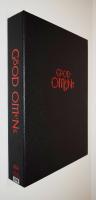 |
Pratchett, Terry and Neil Gaiman. Good omens. The nice and accurate prophecies of Agnes Nutter, witch. Illustrated with line drawings and colour plates by Paul Kidby. London, Dunmanifestin (2019). Gr.-4° (31 x 23,7 cm.). 278 S. mit 20 Farbtafeln und Illustrationen von Paul Kidby. Illustr. Orig.-Pappband in Buch-Kassette in Schlangenleder-Optik.
Eines von 1655 num. Exemplaren; von Paul Kidby signiert. – One of 1655 limited copies. Stunning collectors’ hardback in a snakeskin effect solander box, with metallic red page edges, 20 colour illustrations with additional pencil illustrations. Numbered tipped-in sheet signed by Paul Kidby. – „Working with Terry was a life-enriching experience for me, both professionally and personally. He had so much to say and do, books to write, orang-utans to save, campaigns to wage. His creative energy was irrepressible, always questing and dynamic – brimming over with ideas and plots that needed pinning down. Never one to sit back, Terry had so much that he wanted to achieve, and in the final years, as he was all too aware, there just wasn’t enough time. If I could speak to Terry again, I’d thank him for writing the books that are my greatest source of creative inspiration, and for the belief and encouragement he showed by giving me the fantastic opportunity to illustrate his writing. I’d thank him for the laughs and friendship we shared too. I remember snippets of our conversations about folklore, astronomy, gardening and recipes for nettle soup. We shared an affinity for the chalk downlands where we both lived for a time, the landscape seemed to exert a creative energy for us both. My dog and I tramped many of the ancient drove roads that traverse the grassy backbone of the downs, I knew well the wide skies, the far-reaching views and the leaping hare that he described. Blue butterflies, skylarks, soaring buzzards and harebells in the close-cropped turf were all observed on my walks, and many a flint and fossil weighted my pockets – including the shepherd’s crown“ (Paul Kidby). Schlagwörter: Fantasy, Illustrated books, Illustrierte Bücher, Nummerierte Bücher, Phantastik / Utopie, Signed books, Signierte Bücher, Vorzugsausgaben |
500,-- | |
 |
Tolkien, J(ohn) R(onald) R(euel). The lord of the rings. I. The fellowship of the ring. – II. The two towers. – III. The return of the king. Second edition, fourth (and) third (III) impression. 3 volumes. London, Allen & Unwin (1968-1869). 8°. 423, (1) p.; 352 p.; 440 p. with 3 folded maps in black and red. Original dark red cloth, gilt lettered spines and illustrated dustjackets.
LKJ III, 547 f. – Eine der letzten Ausgaben in 1960er Jahren; die erste deutsche Übersetzung erschien ebenfalls erst 1969 bis 1970. – „In „Lord of the rings“ drückt sich eine Abneigung gegen die moderne Gesellschaft und eine Sehnsucht nach vorindustriellen Zuständen aus. So wird T. auch von seiner derzeit größten Anhängerschar, den Jugendlichen, begriffen, die ihren Überdruß am Bestehenden und ihre Sehnsucht nach Neuem von H. HESSE und T. am besten dargestellt sehen“ (W. Neumann in LKJ). – Schutzumschlag von Band III an den Gelenken geringfügig berieben, sehr gutes Exemplar. Schlagwörter: Fantasy, Phantastik / Utopie, Phantastische Literatur |
750,-- | |
 |
Borges, Jorge Luis (Hrsg.). Meisterwerke der Phantastischen Weltliteratur. (Sonderausgabe der Edition Weitbrecht). 15 Bände. Stuttgart, Thienemanns Verlag (ca. 1983). Gr.-8°. Ca. 4000 S. mit zahlr. Illustrationen von Aubrey Bearsdsley. Schwarz-weiß illustr. Orig.-Pappbände.
Neuwertiges Exemplar. Schlagwörter: Fantasie, Fantastik, Horror, Phantastik / Utopie |
100,-- | |
 |
Wells, H(erbert) G(eorge). Les premiers hommes dans la lune. Traduit de l’anglais par Henry-D(urand) Davray. Illustrations de Martin van Maële (d. i. Maurice François Alfred Martin van Miële). Paris, Félix Juven o. J. (1901). 4° (27,5 x 20 cm.). 296 S., [2] Bl. mit 16 (4 farb.) Tafeln in Holzstich, zahlr. Illustrationen im Text und Jugendstil-Buchschmuck. Weinroter Orig.-Leinenband mit goldgepr. Rücken- und Deckeltitel und goldgepr. Deckelillustration (″Selenite“) sowie Goldschnitt.
Crossly, H. G. Wells S. 50 ff. McLean, The Early Fiction of H.G. Wells: Fantasies of Science S. 117 ff. Nicholls, The Encyclopedia of Science Fiction 360 ff. Perry, Van Maele 63. – Erste französische Ausgabe und erste Ausgabe mit den Illustrationen von M. van Maele. – Die englische Originalausgabe des berühmten Mondromans von G. G. Wells erschien zuerst im Strand Magazine und The Cosmopolitan von November 1900 bis Juni 1901 mit dem Titel „The First Men in the Moon“. Die erste Buchausgabe erschien 1901 bei George Newnes in London. Felix Juven veröffentlichte 1901 drei Ausgaben, die vorliegende Luxusausgabe mit farb- und schwarzweiß Illustrationen, eine billigere Ausgabe nur mit schwarzweiß Illustrationen und eine „Volksausgabe“ ohne Illustrationen. – Die Darstellung des Mondbewohners (″Selenite“) auf dem Einband wurde in späteren Auflagen gegen eine Rakete ersetzt. – Der franz. Zeichner und Illustrator M. van Maele (1863-1926) arbeitete in Brüssel und Paris und war vor allem für seine erotischen Illustrationen berühmt. Für F. Juven hat Van Maele auch „Aventures Extraordinaires“ (Sherlock Holmes) von Conan Doyle ausgestattet (1902). – „The inspiration seems to come from the famous 1865 book by Jules Verne, From the Earth to the Moon, and the opera by Jacques Offenbach from 1875. Verne’s novel also uses the word „Selenites“ to describe inhabitants of the Moon. … Soon after the publication of The First Men in the Moon, Wells was accused by the Irish writer Robert Cromie of having stolen from his novel A Plunge into Space (1890), which used an antigravity device similar to that in Chrysostom Trueman’s The History of a Voyage to the Moon (1864). Both novels had certain elements in common, such as a globular spaceship built in secret after inventing a way to overcome Earth’s gravity. Wells simply replied: „I have never heard of Mr Cromie nor of the book he attempts to advertise by insinuations of plagiarism on my part.“ Jules Verne was publicly hostile to Wells’s novel, mainly due to Wells having his characters go to the Moon via a totally fictional creation of an anti-gravitational material rather than the actual use of technology“ (Wikipedia). – Rücken etwas aufgehellt, Vorderdeckel im unteren Drittel mit schwachem Fleck, vereinzelt etwas braun- und fingerfleckig, sehr gutes Exemplar. – Première édition française et première édition avec les illustrations de M. van Maele. – L’édition originale anglaise du célèbre roman lunaire de G. G. Wells a d’abord été publiée dans Strand Magazine et The Cosmopolitan de novembre 1900 à juin 1901 sous le titre « The First Men in the Moon ». La première édition en livre est parue en 1901 chez George Newnes à Londres. Felix Juven publia trois éditions en 1901, la présente édition de luxe avec des illustrations en couleur et en noir et blanc, une édition moins chère avec uniquement des illustrations en noir et blanc et une édition « populaire » sans illustrations. – La représentation de l’habitant de la lune (« sélénite ») sur la couverture a été remplacée par une fusée dans les éditions ultérieures. – Le dessinateur français. Le dessinateur et illustrateur M. van Maele (1863-1926) travailla à Bruxelles et à Paris et fut surtout célèbre pour ses illustrations érotiques. Pour f. Juven, Van Maele a également décoré « Aventures Extraordinaires » (Sherlock Holmes) de Conan Doyle (1902). – L’inspiration semble venir du célèbre livre de Jules Verne de 1865, De la Terre à la Lune, et de l’opéra de Jacques Offenbach de 1875. Le roman de Jules Verne utilise également le mot « Sélénites » pour décrire les habitants de la Lune. … Peu après la publication des Premiers hommes sur la Lune, Wells a été accusé par l’écrivain irlandais Robert Cromie d’avoir volé son roman A Plunge into Space (1890), qui utilisait un dispositif antigravitationnel similaire à celui de The History of a Voyage to the Moon (1864) de Chrysostom Trueman. Les deux romans avaient certains éléments en commun, comme un vaisseau spatial globulaire construit en secret après avoir inventé un moyen de vaincre la gravité terrestre. Wells a simplement répondu : « Je n’ai jamais entendu parler de M. Cromie ni du livre dont il tente de faire la publicité en insinuant que je l’ai plagié ». Jules Verne s’est montré publiquement hostile au roman de Wells, principalement parce que ce dernier a envoyé ses personnages sur la Lune par le biais d’une création totalement fictive d’un matériau antigravitationnel plutôt que par l’utilisation réelle d’une technologie » (Wikipedia). – Dos un peu éclairci, première de couverture avec une faible tache dans le tiers inférieur, quelques rousseurs et taches de doigts éparses, très bon exemplaire. Schlagwörter: Illustrated books, Illustrierte Bücher, Phantastik / Utopie, Science Fiction |
4.500,-- | |
 |
Brjussoff (Brjusov), Valerij (Jakovlevic). Die Republik des Südkreuzes. Novellen. „Dieses Exemplar gehört zur 2. Auflage.“ München, Hans von Weber 1908. Gr.-8°. 108 S., [1] Bl. OPbd. mit goldgepr. Rücken- und Deckeltitel und goldgepr. Deckelillustration.
Hayn/G. I, 472. KNLL III, 190. – Erste deutsche Ausgabe. – Als 2. Auflage bezeichnete Normalausgabe, neben der gleichzeitig erschienen Vorzugsausgabe in 50 Exemplaren. – Die russische Originalausgabe erschien 1905 in Moskau. – Die dystopische Titelgeschichte schildert den Zusammenbruch einer fiktiven Wohlfahrtsdiktatur in der Antarktis. – „Mit Vergewaltigung, Mord, Raub, Menschenfresserei und Totschlag richtet sich das Volk in einem letzten Bacchanal der Grausamkeiten und sexuellen Exzesse selbst zugrund“. Brjussovs Zivilisationskritik geht „von Nietzsches Kategorie des Dionysischen aus, das die ‚dünne, obgleich jahrtausendealte Rinde‘ der Kultur durchbricht“ (KNLL III, 190). – Enthält außerdem die Novellen: „Die Schwestern“, „Im unterirdischen Kerker“, „Die letzten Märtyrer“, „Jetzt wo ich erwacht bin“, „Im Spiegel“ und „Das Köpfchen aus Marmor“. – V. J. Brjusov (1873-1924), Begründer des russischen Symbolismus, „trat 1920 im Gegensatz zu den anderen Symbolisten der Kommunistischen Partei bei. In verschiedenen Positionen künstlerischer Institutionen vor allem organisatorisch tätig, begründete er 1921 die Hochschule für Literatur und Kunst“ (Wikipedia). – „(W)enn Brjussof nicht so selbständig wäre, [könnte man] ihn gern den russichen Poe oder Hoffmann nennen“ (Aus dem Verlagsprospekt, zitiert nach Hayn/Gotendorf). – Sehr gutes sauberes Exemplar. Schlagwörter: Phantastik / Utopie, Phantastische Literatur, Utopie |
120,-- | |
 |
(Vairasse auch Veiras, Denis). Histoire des Sevarambes. Peuples qui habitent une partie du troisième continent, communément appellé la Terre Australe. Contenant une relation du gouvernement, des mœurs, de la religion & du langage de cette nation, inconnue jusques à présent aux peuples de l’Europe. Nouvelle édition, corrigée & augmentée. 2 Bände in 1. Amsterdam, Henry Desboredes 1734. Kl.-8°. [9] Bl., 273 S.; 247 S. mit Titel in Rot u. Schwarz. Kalbslederband der Zeit mit goldgepr. Rückenschild u. floraler Rückenvergoldung.
Barbier II, 768. Emanuel von der Mühll, Denis Veiras et son Histoire des Sévarambes, Paris 1938 (ausführl.). Vgl. Bloch, Utopie 3184 u. Cox II, 473 (frühere Ausgaben). Nicht bei Cioranescu u. Brunet. – Spätere Ausgabe der erstmals 1677-1678 erschienenen utopischen Reiseschilderung, die sowohl D. Defoe als auch J. Swift beeinflusste. – D. Vairasse (um 1635-um 1700) „ging als südfranzösischer Hugenotte nach England und schrieb dort seinen (zuerst englisch, dann französisch publizierten) utopischen Roman History of the Sevarambians, von dessen französischer Fassung seit 2001 eine kritische Ausgabe vorliegt“ (Wikipedia). – Schönes dekorativ gebundenes Exemplar. Schlagwörter: Literatur, Phantastik / Utopie, Utopie |
280,-- | |
|
Einträge 1–7 von 7
Zurück · Vor
|
|||
| Seite: 1 |